[Editor's Note: This is the eighth installment of our “Outlook 2009” series, which looks at the global investing outlook for the New Year.]
President-elect Barack Obama has made no bones about wanting to jump-start the renewable energy markets – pledging $150 billion for the development of biofuels, solar and wind power, other alternative energy sources during his first term.
But what might the new administration mean for more traditional – and more reliable –energy sources?
Oil is always the first energy source to spring to mind. But it’s hardly a solo act – coal and nuclear make up the other two-thirds of the top fuel trio. Coal delivers 50% of U.S. electricity needs, and nuclear power brings another 20% to the table.
The cold truth is that demand for energy of all types – and especially electricity – is going to keep advancing, domestically and worldwide. And developing alternatives to coal and nuclear will take time. For instance, tying wind and solar into the existing power grid will be enormously expensive and is likely to pose massive technical and engineering problems.
In fact, according to the International Energy Agency, renewable energy isn’t likely to make a meaningful dent in meeting the world’s energy needs before 2030, if then.
And regardless where the power comes from, our appetite for electricity will continue to skyrocket. Across the planet, overall electricity consumption is expected to double by 2030, increasing by 17 trillion kilowatt hours. While electricity demand will “only” increase by 50% in the U.S. market by 2030, demand will increase 400% in China and six-fold in India.
Our research indicates that President Obama will have very little flexibility in solving our short-term energy problems once he’s sworn into office next month. While he may prefer the environmentally friendly alternatives, most of those replacements are far from fully developed.
The bottom line: Obama’s apparent preference for renewable energy aside, coal and nuclear power are fully deployed, and in widespread use, meaning they’ll remain the backbone of our energy sector in the New Year – and for years to come.
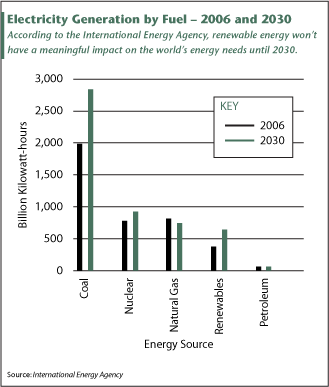
Even so, it’s well worth factoring in all the possible players as we examine energy-sector outlook – and the accompanying potential profit plays – for the next 12 months.
King Coal Reigns Supreme
When it comes to future energy profits for investors, coal and nuclear will continue to be the “dream team” for years to come. Coal will provide the answer to our short-term and intermediate energy needs. It’s plentiful, it’s cheaper than other available alternatives, and a big percentage of the world’s power plants burn it.
Nuclear power offers a long-term solution to energy shortages and a clean solution to global warming, as well. Uranium-fueled nuclear plants are cheap to operate, can run for long periods without refueling, and cause little pollution.
While there is widespread distaste for coal-fired power plants that spew billions of tons of carbon dioxide and other pollutants into the air, there’s no doubt coal will continue to be the dominant player in the electricity game for some time to come.
A full 50% of the electricity U.S. consumers use is generated by coal, and coal is king in the rest of the world, as well. According to the IEA, coal accounted for 42% of all worldwide electricity consumption in 2005.
But get this – the agency predicts coal use will explode by 73% over the next 20 years. That’s the largest projected percentage increase of all energy sources.
As you might suspect, China and India use 45% of world’s coal and will be responsible for 80% of that increase. China, alone, uses more coal than the United States, Japan and Europe combined. China is utterly dependent on coal to run its factories and assembly plants, with coal supplying 80% of its electricity. The Red Dragon also is the world’s top producer of steel, a process that’s also a big burner of coal.
But while China is coal’s largest consumer and producer, the United States controls 27% of the world’s proven reserves, the biggest-single percentage on the planet. That puts this country front and center on the worldwide coal stage, and President-elect Obama’s energy policy in the spotlight.
The president plays a pivotal role in shaping the nation’s energy policy, naming top officials at the U.S. Environmental Protection Agency (EPA), the Office of Surface Mining Reclamation and Enforcement and the U.S. Army Corps of Engineers.
Obama has proposed an economy-wide cap-and-trade system to reduce carbon emissions by 80% by 2050. His system – which would set an overall emissions limit, then require polluters to buy allowances at public auction – would increase electricity rates and discourage coal consumption in the U.S. market. President-elect Obama even has stated that any utilities building coal-fired plants could go bankrupt buying pollution allowances.
And on Capitol Hill, newly emboldened Democrats recently tackled global warming and other environmental problems by choosing Sen. Henry Waxman, D-Calif., to head the House of Representative’s Energy and Commerce panel. Waxman has already signed onto legislation that would ban any new coal-fired power plants that aren’t built using new technologies that capture carbon dioxide and store it underground, a key part of the Obama energy plan.
Luke Popovich, a spokesman for the National Mining Association, said he believes Obama will be pragmatic about the need to keep coal in the nation’s energy mix.
"He presumably would be sensitive to the impacts of energy policies given the perilous state of the economy," Popovich said.
But while U.S. utilities may eventually be forced to tighten emissions rules and increase rates, Obama’s renewable energy plans will have very little impact on U.S. coal producers in the near future.
The world needs coal. We have it. And we’re going to sell it.
In the first half of 2008, U.S. coal exports increased by 13 million short tons, or 50%, over first-half 2007 shipments, according to the IEA. Strong global demand for coal, combined with supply disruptions in several key coal exporting countries (Australia, South Africa and China), were the primary factors behind the increase.
But lately, coal prices, along with the prices of other fossil fuels, have suffered from the global economic crisis, and from a resurgent U.S. dollar. An 80% decline in global shipping rates has also fostered competition from other exporters, like Australia, which can now ship farther and compete with U.S. exporters.
As a result, the price of Appalachian Coal on the New York Mercantile Exchange (CME) has fallen to less than $80 a ton from $143 in July.
This will have a negative impact on coal producers until the world economy is able to gather itself back up and build up a new head of steam.
But don’t expect the slump to last long. China’s economy is getting a shot in the arm from a gigantic $586 billion stimulus package, cementing growth expectations for 2009. Expect U.S.exports to accelerate when that kicks in, probably in the second half of 2009.
Since the stock market usually leads economic indicators by six-to-nine months, right now is a good time to be looking at candidates for your investing dollar. But you should be cautious about pulling the trigger. Watch construction activity in China – especially steel demand in the late spring – for the first signs of a rebound in coal prices.
When you think things are ready to take off, Peabody Energy Corp. (BTU) and Arch Coal Inc. (ACI) – the largest U.S. producers – are worth a look. For those who like to play a basket of shares, the Market Vectors Coal exchange traded fund (KOL), or ETF, provides the desired diversification. All three securities are trading at discounts of at least 80% from their July highs, and currently trade at bargain basement multiples.
If you want a coal play that bets directly on China,
Money Morning Investment Director
Keith Fitz-Gerald likes
Yanzhou Coal Mining Co. Ltd. (ADR: YZC), one of China’s biggest coal suppliers. It produces lots of high-grade, low-sulfur coal, which burns cleaner and therefore fetches a premium price. The company boasts profit margins of 22%, when the industry averages half that. The company profits are up a blistering 364% in the year’s first three quarters, compared with a year ago. The stock trades at only three times earnings and has a dividend yield of 4.3%.
Nuclear Power: It Struggles in the U.S., but Thrives Abroad
Nuclear power is attractive to the energy industry because it produces electricity on a predictable, 24-hour basis – earning it the industry sobriquet of “base load” power. Coal and hydroelectric plants are the only other power sources that also rate that label. Such alternatives as wind, solar or biofuels do not.
During its term, the Bush administration tried to spark a “renaissance” in the construction of nuclear power plants. And during his presidential campaign, Sen. John McCain stood firmly behind the industry’s hopes of building 45 new reactors by 2030.
Interest in new types of reactors seemed to hint at least at the beginnings of a new start. But President-elect Obama has been lukewarm on nuclear. He acknowledges that nuclear is one of several viable components of the nation’s energy portfolio – the current 104-plant fleet provides 20% of America’s electricity – but has questioned its safety while emphasizing a need to diversify the nation’s energy mix with more wind, solar and other renewable sources.
"That’s sort of like my wife saying she’d support divorce under certain situations," says William Kovacs, the U.S. Chamber of Commerce’s vice president of environment, technology, and public affairs.
In fact, the Barack Obama/Joe Biden New Energy for America Plan, while recognizing that nukes provide 70% of our non-carbon-generated electricity, says that “before an expansion of nuclear power is considered, key issues must be addressed including: security of nuclear fuel and waste, waste storage and proliferation.” It goes on to say that the team of President-elect Obama and incoming Vice President Joe Biden
“do not believe that Yucca Mountain is a suitable site as a long-term repository for spent nuclear designed for long-term storage. In any case, the earliest the storage site could open would be 2017, and that was before Republicans lost control of the Senate.
With Senate Majority Leader Harry Reid, D-Nev., firmly opposed to nuclear waste storage in his home state – and with the Obama administration ready to hold the industry’s feet to the regulatory fire – any plans to expand the nuclear industry in the United States now face a high hurdle.
But nuclear proponents are hardly impotent. The Nuclear Energy Institute, the industry’s most powerful lobbying group, helped craft the Energy Policy Act of 2005 with more than $12 billion in subsidies for nukes.
Maintaining nuclear energy’s current 20% share of generation would require building three reactors every two years starting in 2016, based on U.S. Department of Energy forecasts. Right now, some 17 companies and consortia are pursuing licenses for more than 30 nuclear power plants with the Nuclear Regulatory Commission.
But the last operating license for a nuclear plant in the United States was issued in 1978, and the approval process takes a minimum of 24 months after site approval, which can take years. Expect lots of public comment and infighting in Washington, as applications wind their way through the approval process at the NRC.
Meanwhile, the rest of the world is racing ahead with plans to up the ante in the nuclear power game. There are currently 440 nuclear reactors in 31 countries that generate about 16% of the world’s electricity.
Uranium-fueled nuclear energy is rapidly gaining global acceptance as a clean, reliable alternative to such dirty-burning fossil fuels as coal and oil. In a twin bid to combat global warming and keep up with soaring demand for electricity, countries are rushing to build nuclear power plants. Under current projections, 630 reactors will be operating in 55 countries by 2030.
It’s the new technologies those reactors are designed around that are aimed at allaying the public’s perception about the safety of nuclear power. Toshiba Plant & System Services, which has built 112 plants in the past 12 years (more than any other company), is working on a “mininuke,” according to
Forbes magazine. Called the “4S” (short for
Super-
Safe,
Small and
Simple), it uses a bath of molten sodium to produce steam twice as hot as steam from water-cooled reactors. The 4S can crank out as much as 50 megawatts of power, easily enough to fire up a small factory, or to service an entire town that’s located off the main power grid.
On top of that, the mininuke can go 30 years without refueling, as opposed to typical reactors, which must be fed every 18 months. And the 4S will be safer, because the reactor core is deep underground, well protected against a terrorist attack or earthquakes.
China and South Africa are working on so-called “pebble-bed reactors,” one version of which is filled with 100,000 billiard-ball-sized spheres of coated uranium that are cooled by helium. That eliminates the need for enormous pressurized water-cooling systems and million-dollar containment domes, making them virtually meltdown-proof.
U.S. firms are also on the trail of smaller and safer designs. A Santa Fe, NM company called Hyperion Power Generation Inc., is working on a hot-tub sized design, which eliminates the need for the notoriously unstable uranium control rods. U.S. giant General Electric Co. (GE) is working on new, more efficient designs, as well.
No matter how you slice it, the fuel for the reactors in those plants all depend on a scarce commodity – uranium. Flat out, there’s just not enough “yellow cake” to go around. It takes seven to 10 years to transform a uranium discovery into a fully operational mine. With that kind of lag time, it’s clearly almost impossible for supply to keep up with demand.
Until recently, the market reflected the scarcity, rising as high as $137 a pound in 2007. But lately, despite the global shortages, uranium prices – in sympathy with other commodity prices – have nosedived.
Prices have fallen 40% this year, leading to a sharp decline in the share prices of mining companies, and eviscerating the financing for extraction projects. In the last month alone, six uranium mines in western Colorado and Utah were either put on hold or closed.
Some experts lay the blame for this current credit squeeze squarely at the feet of hedge funds – who they blame for buying up uranium – and banks no longer willing to lend money.
“Hedge funds were selling off their uranium to raise cash, and the prices just plunged,” said George E.L. Glasier, chief executive officer of Energy Fuels Inc., a Canadian junior miner that recently put a Colorado mine project on hold as part of a “capital preservation” strategy brought on by the credit crunch.
Uranium prices fell to $75 early this year, and fell as low as $44 this fall. The spot price now is $55.
With the worldwide growth in the industry – and a classic supply/demand imbalance in the making – someone is eventually going to have to pay the price. History shows when uranium prices move higher, uranium stocks almost always hitch a ride North. So when uranium prices advance – most likely to new highs – expect mining stocks to rise in virtual lock step.
But notwithstanding global growth – for now, at least – Obama’s energy plan and the mothballing of mines makes any uranium play a long-term proposition.
Besides Toshiba
(PINK:TOSBF), the stocks to consider include Cameco Corp. (CCJ), the largest U.S. producer; and General Electric, which has a presence in the commercial nuclear power market here and overseas. Also, take a look at Rio Tinto PLC (RTP) and BHP Billiton Ltd. (BHP), huge international mining firms with large uranium deposits. Each of these firms would stand to reap substantial profits from a resurgent price in yellow cake.
Outlook 2009 – and Beyond
However, regardless of what uranium does, coal is still the 800-pound gorilla in the energy world. In the United States, no matter how lofty our environmental intentions may be, it’s unlikely coal will be regulated out of existence anytime soon. That’s especially true overseas, where coal is playing a crucial role, fueling the transformation of such countries as China and India from “emerging markets” into first-order powerhouse economies. Given that, the world market simply can’t replace coal anytime soon, either.
As for nuclear power, safety improvements and other technological solutions make nuclear energy a viable energy source for the long term, eventually grabbing a bigger piece of the energy pie – especially overseas.
The bottom line: The economic outlook for both coal and nuclear power is upbeat. Investors might look at both energy plays when considering how to allocate their portfolio – for the New Year and beyond.
[Editor’s Note: Money Morning’s “Outlook 2009” economic forecasting series last looked at the outlook for retail sales in the New Year. Next up: Latin America. Check out past series stories, which have underscored that uncertainty will continue to be the watchword for at least the first part of the New Year. Little wonder, as the global financial crisis continues to whipsaw the U.S. financial markets in a manner that hasn’t been seen since the Great Depression. It’s almost enough to make you surrender. But what if you knew, ahead of time, what marketplace changes to expect? Then you’d be in the driver’s seat – right? You’d know what to anticipate, could craft a profit strategy to follow, and could then just sit back, watching and waiting – and finally profiting from – the very marketplace events you anticipated.
R. Shah Gilani – a retired hedge fund manager and a nationally known expert on the U.S. credit crisis– has predicted five key financial crisis “aftershocks” that he says will create substantial profit opportunities for investors who know just what these aftershocks are, and how to play them. In the
Trigger Event Strategist, Gilani describes how investors can use these aftershocks, or “trigger events,” as gateways to massive profits. To find out all about these five financial-crisis aftershocks, and about the trigger-event profit strategy they feed into, check out our latest report.] (ArticlesBase SC #684002)


